 Michael Fertman
Why Do New Products Launch on Time but Fail to Sell?
New products launch on time but fail to sell because companies plan the launch around product readiness, while selling depends on sales readiness. Four things cause the gap: nobody owns the product's revenue target, the product launch crowds out the go-to-market launch, sellers hit their number faster with existing products, and the launch date is set before anything is proven.
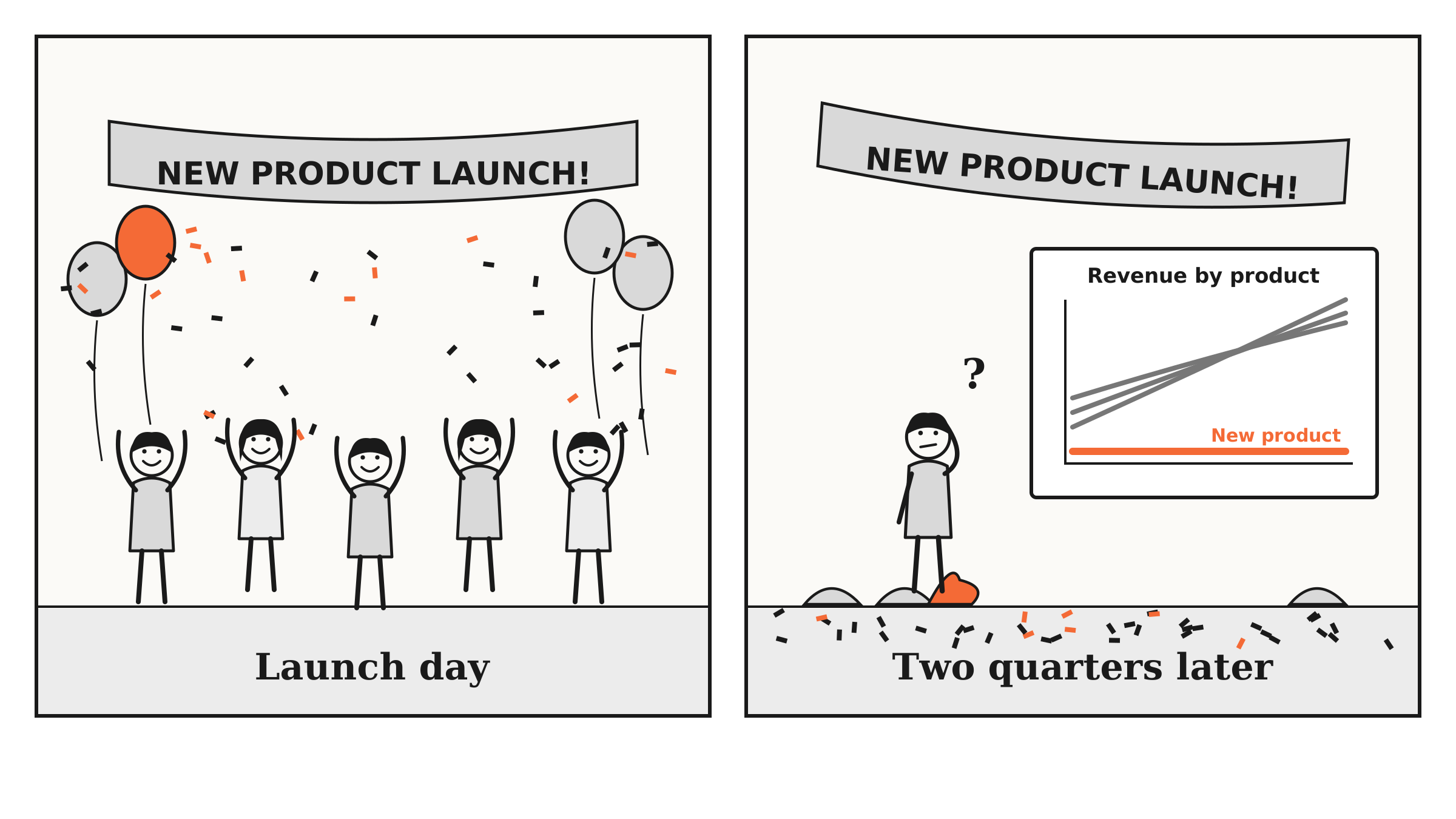
The product launched on time.
Bloomberg ran a piece with a Fortune 100 testimonial.
The CEO's launch post was reposted all week.
The whole team crushed it!
Two quarters later, sales is crushing it too. Teams are well on their way to beating plan.
Then you sit down in the launch review and find out nobody is selling the new product. They're selling the same core product they've always sold.
Every other product's revenue is up, while the new one is holding steady at close to zero.
Many companies run two launches and plan only one
Every new product needs two launches:
The product launch gets the product built, tested and released.
The go-to-market (GTM) launch gets the company ready to sell it: the right buyers, a price they will pay and a pitch that works.
Many companies plan the first launch in detail and expect the second to follow on its own. But the two launches have different owners and different definitions of ready.
The product launch is planned around product readiness
Product readiness means the product is built, tested and released. The product launch has a plan everyone can see: a roadmap, a beta, release gates and a date the board already knows. Many teams think the go-to-market launch is the same thing: drop off dozens of materials, send a press release and run a two-day social campaign.
It's like giving a baseball team a stadium, TV advertising, and the best equipment and coaches on the planet, then starting the season with no preparation except a lecture on how to win.
Building sales expertise with a new product or customer segment is a process, not a switch we flip.
The go-to-market launch depends on sales readiness
Sales readiness means sellers have a proven buyer, price and pitch. The go-to-market launch depends on answers only the market can give. Who exactly buys it? What will they pay? What does a seller say in the first five minutes of a call?
Those answers take months of work with real buyers, and the product plan has no time set aside for them.
Real baseball teams get spring training. They test their players in live games to learn how to win as a team.
Four reasons sales isn't ready on product launch day
Nobody owns the product's revenue target
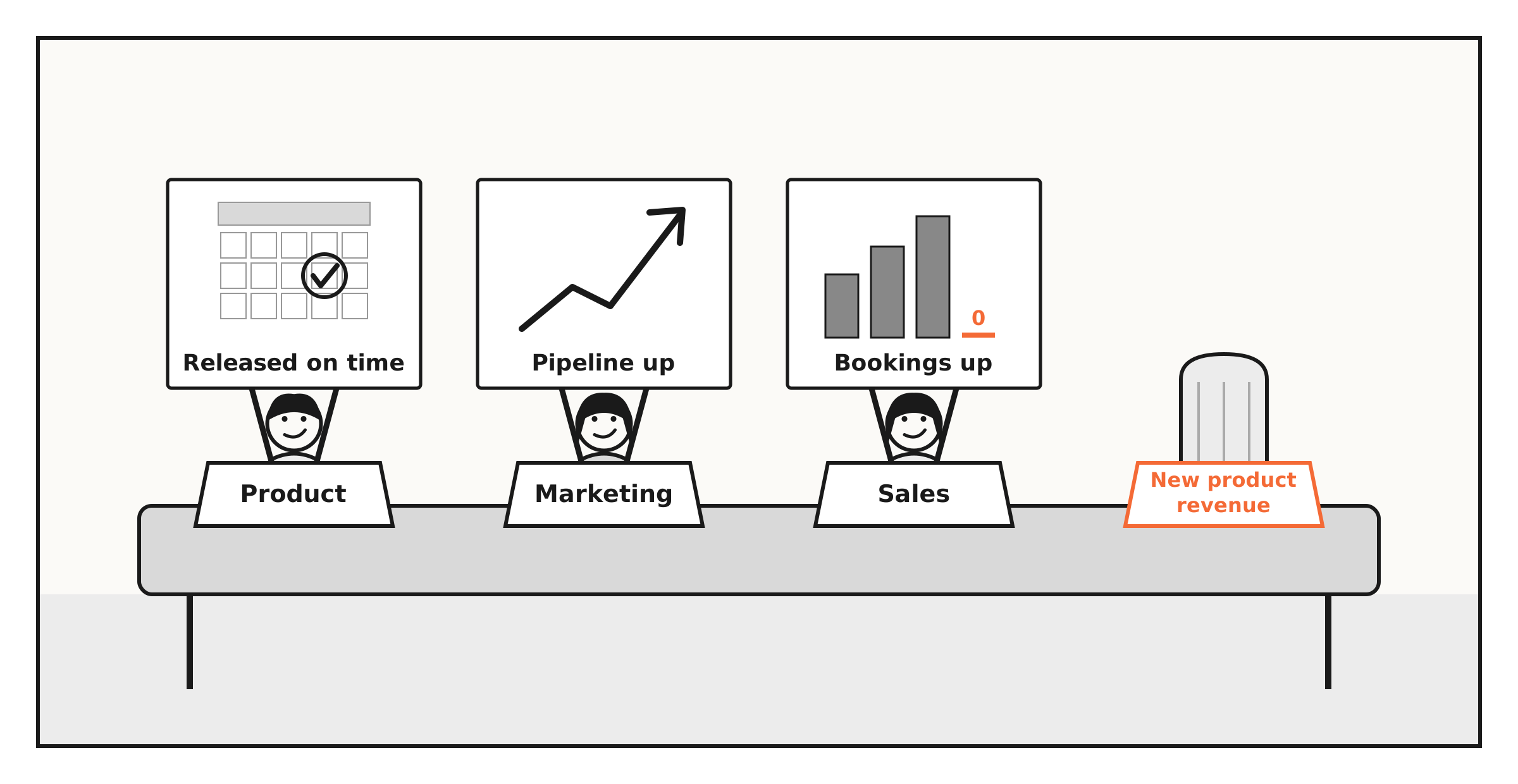
Everyone owns a number. Nobody owns THE number.
New products are likely to miss their revenue targets if nobody is accountable for achieving them.
Product owns the roadmap and the release date. Sales owns quota, mostly on the core products. Marketing owns pipeline, blended across the portfolio.
But no team or person owns product revenue. So the CEO does, by default.
The CRO isn't going to drop everything for 2% of their number.
A director of go-to-market strategy at a $1B SaaS company put numbers on the gap. Say the chief revenue officer (CRO) has to deliver $500M in new bookings, and the new product's goal is $10M. That's 2% of their number.
At Dun & Bradstreet, product owners were accountable for product revenue. The sales team was responsible for topline sales. So we pushed with urgency. A sale closed in December added one month of revenue to the year. A sale closed in January added 12. For a public company, that timing mattered.
We owned positioning, packaging, pricing and sales enablement end to end, down to approving discounts and supporting deals. We were internal salespeople, selling to our own sales team, and we delivered most of our growth with almost no promotion beyond events and marketing to existing clients.
This gap appears almost everywhere in the messy middle, the companies growing from $25M to $100M, $500M and beyond. As they grow, the old launch model, with product leading and all hands on deck, stops working, because there are too many products and channels to manage the way they did before.
We need revenue accountability by sales channel and by product to win. Otherwise, product has no financial incentive to deliver products that sales can sell and customers want to buy.
None of the companies I've worked with since Guidepoint in 2013 assigned product-level revenue targets. They set only overall sales targets, and often focused completely on new logos. And almost all of their launches fall flat until the next year's sales compensation plan gives sellers a full year to build pipeline and close.
The product launch crowds out the go-to-market launch
Product managers often run the go-to-market launch between their other jobs, and product delivery wins every time the release date is at risk. So go-to-market work gets pushed into the final weeks, even though its answers take months to validate.
"At [my company], we often launched first and trained after. The product would be out, and then we'd roll training and messaging in waves."
Former senior director of product marketing, $700M software company
In my view, go-to-market work starts when development is approved, 4 to 6 months before general availability.
At a $25M Series B AI software business serving enterprise consumer goods companies, the CEO hired me to lead the launch across product, sales, marketing, customer success, support and finance. The launch generated $1M in pipeline within one quarter, 25% of the company's new mid-stage sales pipeline.
Sellers hit their number faster with existing products
Sellers sell what sells.
Sales is the hero in our story. As a team, they're typically hard-charging and smart. And they do exactly what you pay them to do. If you are paying them to climb the mountain as high and as fast as possible, why would they stop to take scuba lessons?
Sellers adopt a new product the way customers do. A few go first, and the rest wait to see a colleague close a clean deal.
"Sales will go sell products that are proven in the market. They want to take the easiest path to make their quota."
Chief go-to-market and strategy officer, $20B software company
You're an enterprise account executive.
Are you more worried about your existing enterprise pipeline?
Or learning to sell a new product to a new audience?
The launch date is set before anything is proven
The launch date goes on the calendar before anyone tests the target buyer or the price with paying customers. On launch day, sales receives educated guesses and a quota.
Many sellers have lived through a launch with the wrong target, value proposition or pricing. Smart sellers wait.
When the targeting and sales motion are proven before training, salespeople learn that selling the new product can help them hit their targets faster.
What changes when sales readiness sets the date
We don't launch a product unless it has been tested live in production. Why would we launch an unproven, untested go-to-market approach to dozens, or even hundreds, of salespeople? The targeting, packaging, pricing, and sales and customer enablement should all be tested before launch, too.
The sales readiness checklist
Product readiness has a checklist, and sales readiness needs one too. Before the full sales team trains, three things are true:
- Live deals have confirmed the target buyer.
- Real customers have paid the price.
- The pitch has closed business.
Then sellers are trained a month before launch, with a list of the specific companies to call first.
At Dun & Bradstreet, when we did a launch, we did a LAUNCH. First, we agreed with sales on the target and what they needed to hit it.
Then product, one product marketer and two or three of our best sellers ran the sales motion with the customers we wanted most. Only then did we launch nationally or globally, with in-person certification for a 1,000-person sales organization through a train-the-trainers model. We repositioned, repackaged or relaunched four product lines that way and more than doubled the growth rate of each.
"We realized that we needed a tiger team of people to take this thing to market and learn about it. And as we did that, we got a lot more traction."
Senior vice president of operations, $2.9B software company
Let the first sellers sell the rest of the team
After each launch, I tracked sales adoption, and it usually followed a pattern like this one.
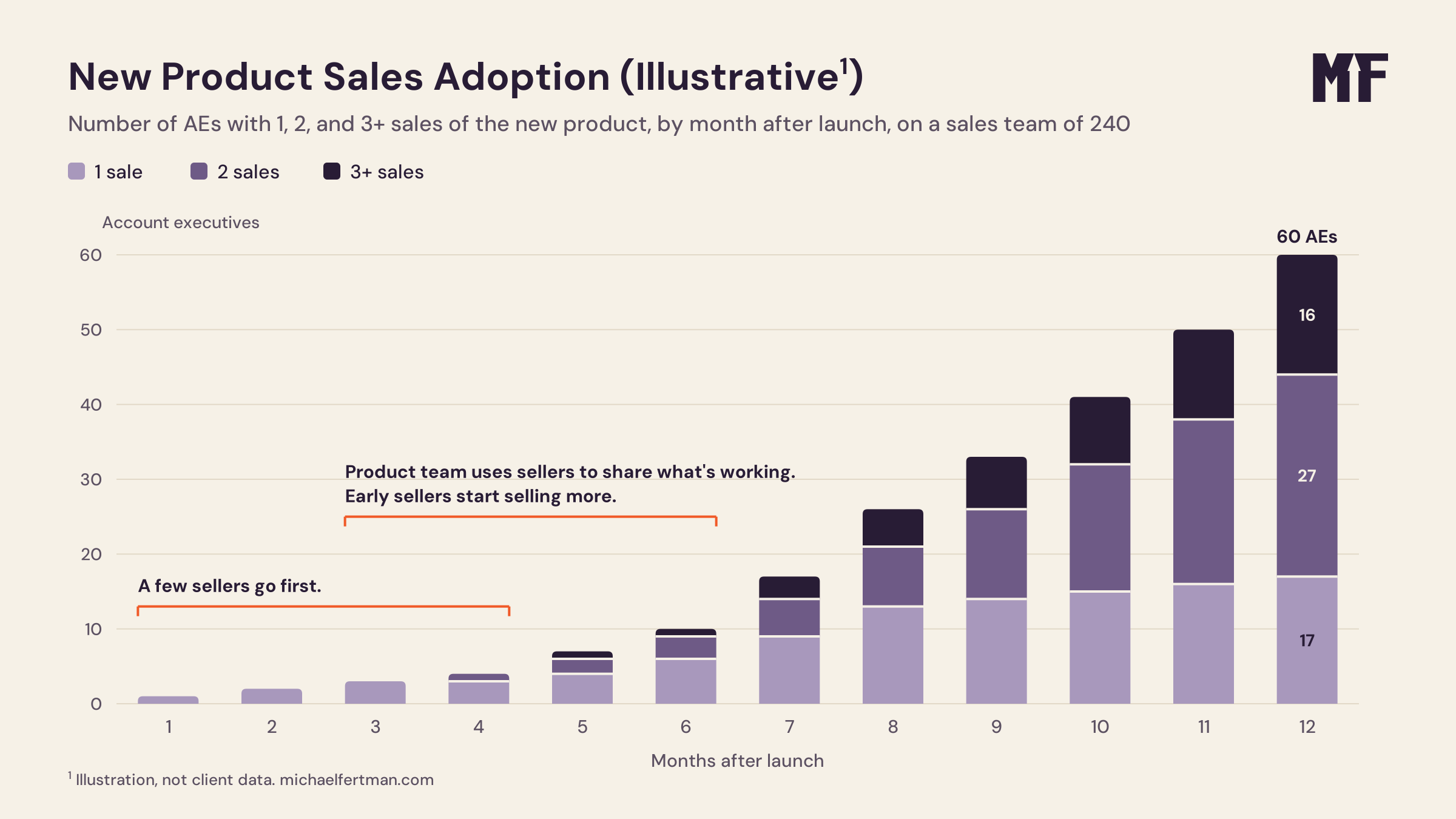
By month 3, only three sellers have closed a deal. You might as well make that an early-access period, so the full team trains on targeting, messaging, a sales motion and onboarding that paying customers have already proven.
Salespeople believe other salespeople more than they believe you (or me). So I get the first sellers to explain how my product helped them hit their number. The more congratulations notes the CEO sends with the sales team copied, the faster adoption spreads.
One person owns the number
In late 2025, I interviewed launch leaders at 15 B2B SaaS companies ranging from $600M to $20B in revenue. About half had one person accountable for a new product's revenue target. One of them, a director of go-to-market strategy at a $1B SaaS company, described their fix for the 2% problem. One VP-level leader owned the $10M as his only goal. He managed no one, and the COO and CMO sat in on his weekly calls to get him whatever he needed.
That is the job I mean. One person carries the new product's revenue target from the day development is approved. I call that person the Commercial Product Leader.
The product team already plans its launch. Plan the second one.
Questions about go-to-market launches
What is a Commercial Product Leader?
A Commercial Product Leader is the one person who carries a new product's revenue target from the day development is approved.
Who should own a new product's revenue target?
One person, a Commercial Product Leader, should carry a revenue target for that product, with the authority to hold product, marketing and sales to it.
When should go-to-market work start?
Go-to-market work should start when development is approved, 4 to 6 months before general availability. That gives the team time to test the buyer and the price with real customers.
Why do sellers wait to sell a new product?
The products they already sell get them to their number faster and with less risk. Many sellers start once they see a colleague close a clean deal on the new product, so the first sellers' wins should be shared with the whole team.
How should a company set a go-to-market launch date?
A company should set the date by sales readiness. The date holds once a small group has closed a handful of paid deals with the target buyer, price and message the full sales team will use.